

Camping Car Travel Expert Taishi Kawanami’s( 川南大士)Tips for Camping Car Travel
A common question we receive from guests is, ‘How long does the battery last?’ or ‘Is external charging necessary?’
So this time, I shall explain about the batteries and charging in our campervans.
Battery and charging method?
- Campervan Batteries
- How much power will you use?
- Charging method
1.Campervan Batteries
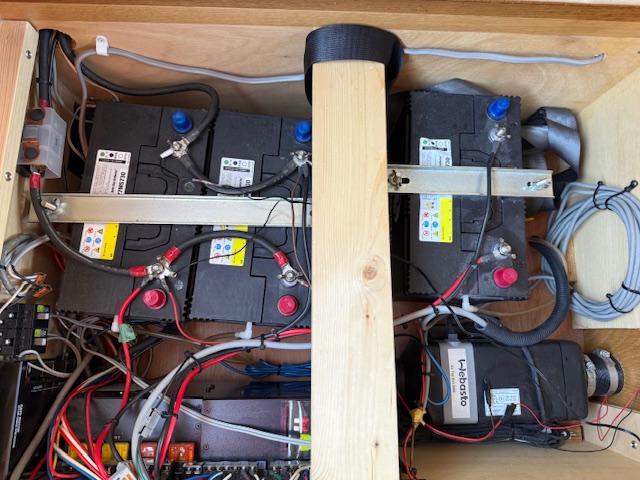
Campervans are equipped with two main types of battery:
Firstly, the main battery, which powers the engine to start and move the vehicle.
It is primarily used for starting the engine and supplying power to electrical components. When starting the engine, it provides the substantial power required to turn the starter motor. While driving, it charges using electricity generated by the alternator (generator). It supplies stable electricity to electrical components such as lights, the car air conditioning, and the car navigation system, which retains settings for the clock and door locks (security) even when the engine is off.
Depending on the vehicle, some have one main battery, while others have two.
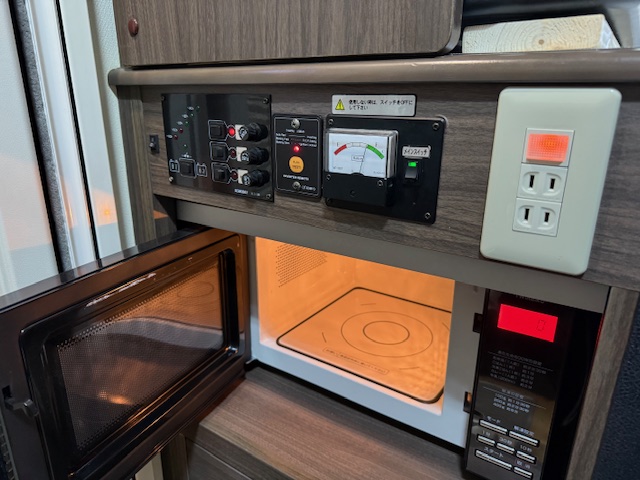
Secondly, the sub-batteries. These serve as a dedicated power source for operating the campervan’s electrical appliances (such as the refrigerator, lighting, FF heater, television, and microwave) whilst the engine is switched off. Operating independently from the main battery, they prevent the main battery from discharging whilst stationary, enabling comfortable overnight stays in the vehicle and outdoor living.
Here too, depending on the vehicle model, between one and three batteries are fitted – the minimum number essential to power the vehicle’s electrical systems.
2.How much power will you use?
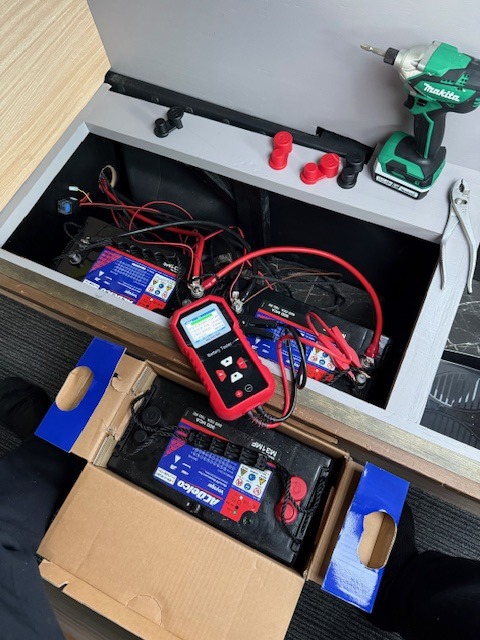
The frequently asked qestion, ‘How long will the battery last?’, depends on how fully charged the sub-battery is and how much electricity is being used.
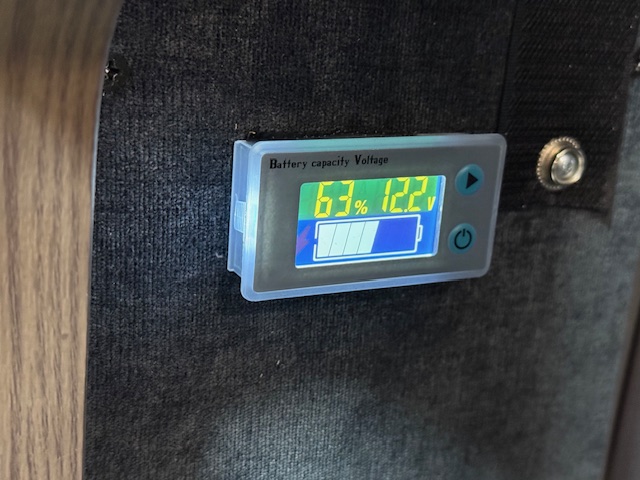
To make this clearer, we install a battery level indicator.
We will briefly ask about your planned itinerary for the trip, what electrical appliances you intend to bring (mobile phones, laptops, hairdryers, etc.), and where you plan to stay overnight. Based on this, we advise you on any points to note.
For example, on Day 1, drive for two hours and stay overnight at a roadside station.
On Day 2, drive for one hour, take a hike along the way, and stay overnight at a roadside station.
On Day 3, drive for two hours, visit some sightseeing spots, and stay overnight at a roadside station.
At night, with lights on and using an inverter (a device that converts 12V electricity stored in the auxiliary battery to 100V, the same as a domestic socket) to power a computer while keeping the refrigerator running, the battery would likely be completely drained by around the third day.
So, the question is: what should you do!? I shall explain this next.
3.Charging method
There are two primary methods for charging the sub-battery.
1,Charging via driving
This system automatically charges the sub-battery via the main battery whenever the engine is started.
If the engine is run for 4 to 5 hours or more daily, the sub-battery will generally be fully charged.
However, if you have completely depleted the power from two or three sub-batteries, running the engine for five hours a day may not fully recharge all batteries. As electrical power is limited, please be mindful not to overuse electricity.
While driving, the system consumes electricity required for essential functions like the car navigation system and air conditioning. The remaining power is then used to charge the sub-batteries.
In other words, charging occurs slowly.
2、External charging
Connecting to external charging points at auto campsites or RV parks will charge the sub-battery.
As many external charging points in Hokkaido provide a 15-ampere current, this will also charge the sub-battery slowly.
Upon arriving at an auto campsite or RV park, it is advisable to connect to the external charging point immediately and disconnect it the following morning before departure.
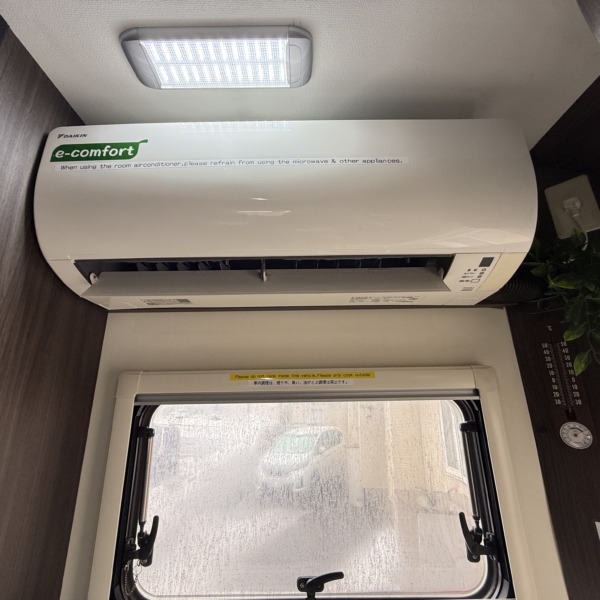
Some vehicles are equipped with a room air conditioner that can be used whilst the engine is off; however, external charging is essential when using the room air conditioner.
Without using external charging, operating the room air conditioner will deplete the sub-battery’s power within approximately three hours.
Once the sub-battery’s power is entirely exhausted, both the lighting and the refrigerator will cease to function.
At roadside stations or highway service areas, the rapid charging points for electric vehicles (EVs) cannot charge the sub-battery due to differing specifications.
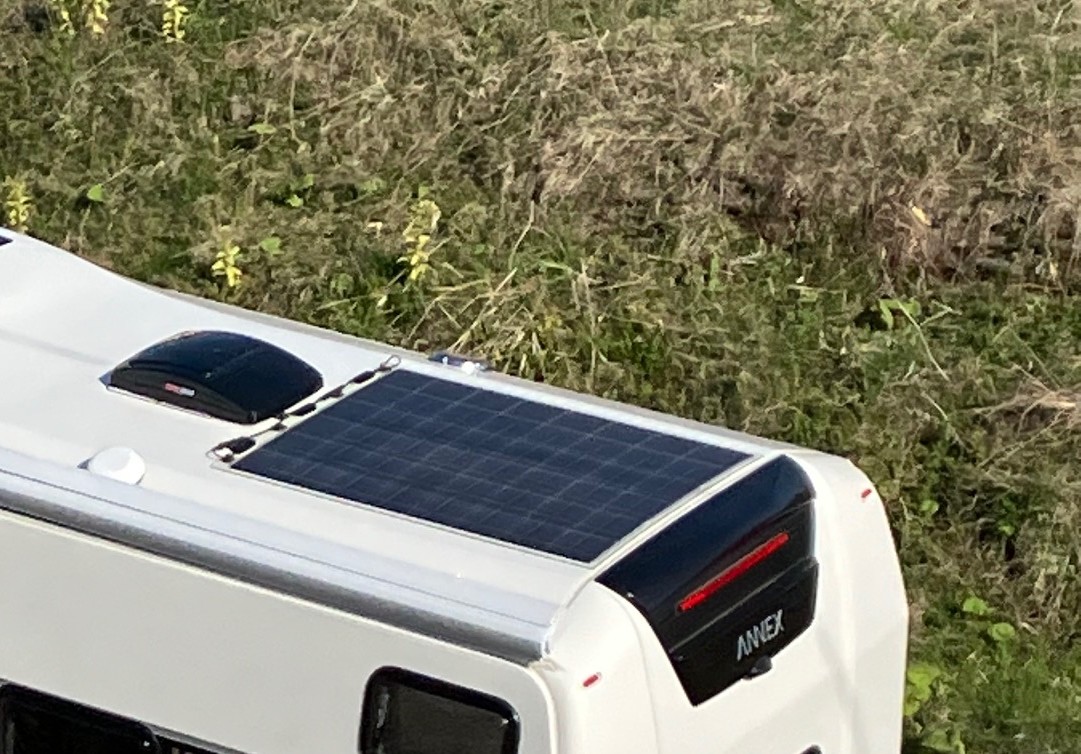
3,Solar panels
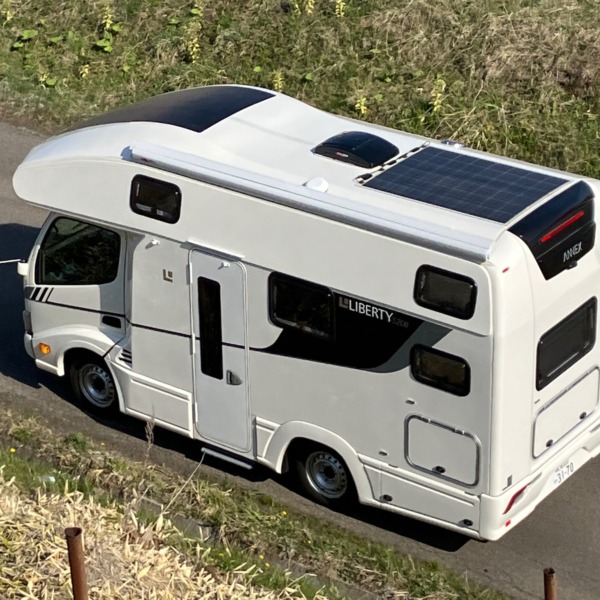
Some models feature solar panels fitted to the vehicle roof section.
That said, the electricity generated by these solar panels is rather weak, and charging occurs very slowly indeed. It is best not to expect a significant amount of charging to occur.
In conclusion,
The key points for charging the sub-battery during a camping van trip are:
Run the engine for at least four hours per day.
If you cannot run the engine for at least four hours per day, stay at campsites or RV parks where external charging is available.
These two points are essential.
When idling with the engine running but not driving, fuel consumption is approximately 2 to 3 litres over 4 hours.
If the price of petrol is ¥160 per litre, and idling for around 4 hours consumes 3 litres of petrol, one might consider that charging costs around ¥480. This could be cheaper than external charging.
The FF heater for winter use also draws power from the sub-battery.
If the sub-battery power runs low, the heater may shut off at night.
Camping cars, unlike hotels, are not designed for unlimited electricity use,
so I find it interesting that you need to plan your trip around how to travel efficiently with limited power.
This time, we covered some tricky battery topics.
Enjoying it or not is entirely up to you!
A beer tastes especially good when your trip goes smoothly.。
Hokkaido Campervan Rental
Camping Car Travel Expert Taishi Kawaminami /川南 大士

- 3-[Tips for campervan travel] The troublesome issue of rubbish on a campervan trip?
- 5-[Tips for campervan travel] Camper AC and FF heater
関連記事一覧
13-[Tips for campervan travel] Go dive into Hokkaido Onsen

“with DO CAMPER” original T-shirt
5-[Tips for campervan travel] Camper AC and FF heater

Wild Hokkaido Tourist Video (Part.1)
11-[Tips for campervan travel] Go dive into Japanese Ramen!

12-[Tips for campervan travel] Go dive into Hokkaido Soft-Serve Ice Cream!
2-[Tips for campervan travel] What are the things to keep in mind when drivin...
Comment